

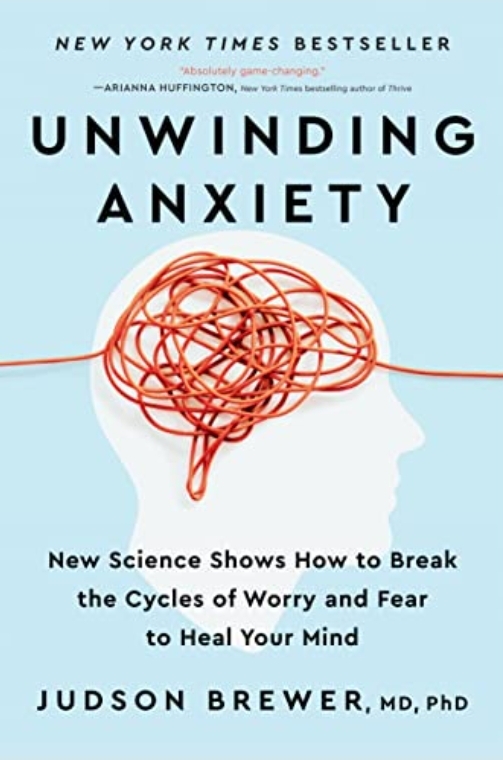
I’ve listened to Unwinding Anxiety a few times through now. I’m reluctant to praise anything too much, because I know how isolating and depressing it can be to want relief and not find it in places where others have. This Review of Unwinding Anxiety comes with a disclaimer.
Applying Brewer’s approach to my own anxiety and IBS seems to be working for me, but it might not be as healing for you. I want you to know that I see and fully acknowledge your struggle.
I’ve been stymied by that battle for what feels like an eternity, and I only drop affiliate links to make this book easier to access if you’re curious. Not because I think there’s a miracle, one-size-fits-all cure for this shit. If nothing else, reading could lead you to discover something that helps you more. That’s all I expect anyone to get from my review today.
But listen to me: if it doesn’t help like you want, it’s not your fault. It’s so important to me that you know that.
I still have anxiety, and I will always be prone to my anxious tendencies. The difference is that now I recognize it, have tools that can help me process it, and can clearly see the benefit of applying those tools.
Like I said a few days ago, I’m not moved much by woo. I prefer hard science, and Judson Brewer broke it down for me in this book. He explained his research plainly, and I found his writing clear but thorough.
Still, I’m the type who picks up on new things every time I read—it’s like when I’m rewatching a favorite movie and I notice something for the first time. I intend to give the audiobook a third listen after the initial ideas in Unwinding Anxiety have had a little more time to simmer.
Unwinding My Own Anxiety
My earliest memorable dealings with anxiety harken back to when I was about 8. I was in bed one night trying to sleep when I thought about the story of John Henry. We’d sung a song about him in music class earlier that week.
When I thought about Henry’s death and then realized my own was inevitable, I struggled to breathe. I felt sick to my stomach and hung out by the toilet for the night. It was my first panic attack, and I have only this week come to understand that’s what was happening.
Unfortunately, my best friend was sleeping over that night, and she wanted to go home. Adult me totally gets it, but little me was kind of heartbroken that my best friend didn’t want to hang out. Her mom or her grandma or someone came to pick her up. I was not just feeling anxious, I was feeling rejected.
My parents tried to console me that night, but I don’t think they understood my experience because I didn’t have words to articulate my fear. Besides, even at 8 years old, I already understood that I should probably just get a grip.
I got that same anxious feeling in my gut about Gifted & Talented class and tried to quit. But the G&T teacher was a hardass. She told me I couldn’t quit unless my parents wrote a note. I thought I’d be a disappointment to them—and I didn’t want to break their hearts—so I stayed in the program and never again brought it up.
And so it went for another 36 years.
I knew when I got stressed and anxious, my IBS would show up, but I had no clue I had developed full-blown generalized anxiety disorder until I heard Brewer define it. Then I remembered the joke I saw on Twitter about all the G&T kids being perfectionists with anxiety.
Hahahaha. Heh.
*nervously glances around room*
That plus recalling Dr. Pulmonologist recently noting the connection between IBS and anxiety caused me to have a lightbulb moment while listening to Unwinding Anxiety.
If I didn’t have a brain tumor to worry about, I might have put the pieces together sooner. After all, I have been diagnosed with anxiety because of my health.
Detailing My Anxiety Loops
Trying to get the anxiety and IBS to stop without understanding the connection was futile. My chronic illness and the physical manifestations of my GAD, were woven too tightly together.
With each new physical symptom, I’d spiral and feed the anxious habits I’d been actively suppressing for a lifetime. Every new doctor’s appointment made it all worse.
The constant internal battle over needing to know what was wrong with me but also needing to not have another expensive doctor’s appointment drain my bank account magnified my anxiety and made my IBS an even bigger problem. To the point I was noticing disordered eating in an attempt not to shit my pants. Sometimes not wanting to eat at all. When I would finally give in and eat because I knew I needed calories to stay alive, there would be even more severe consequences.
When Mom would join us for a meal, I’d stress about getting to the bathroom in time after eating. Or I’d fret about choosing the “wrong” food when ordering takeout, et voilá. I’d give the IBS something to IBS about. I’d try to identify trigger foods only to realize everything caused GI distress and be certain I was hopelessly broken. The suffering was endless.
Also? “You have cancer, we should see if this is cancer too” every few weeks might have been medically sound advice, but it was disastrous for my mental health. My doctors and I didn’t know what we didn’t know.
Pausing My Catastrophic Spirals
Garden variety anxiety had been on my radar for a while. So I tried earnestly to meditate myself to calm. The problem was that my anxiety had anxiety, as they say. Or, put another way, I was anxious I’d be anxious again. I was a hot mess.
I’m still a hot mess, if I’m honest. But Unwinding Anxiety has helped me understand what triggers my anxiety loops, why just mapping the loops helps, and how a subtle shift in how I meditate gets me to recognize what’s happening and press pause on the unraveling.
My brain has always been trying to help, since I was a kid, but I ended up very literally addicted to worry.
Evidence My Anxiety Was Exacerbating My IBS
Grasping for answers made me feel worse. Nothing is clearer to me now. Brewer encourages the anxious who try his approach to not just scrutinize his evidence, but look for their own.
I’m wary of things helping for a short time and ceasing to be therapeutic, BUT
My guts aren’t as inflamed. Which means my lungs have more room to expand and my breathing isn’t as shallow as it was just last week.
I can also hug both of my knees to my chest without any pain in my abdomen—something that inflammation and excruciating pain had made impossible for the last couple of years.
I am still eating “bad” foods, but my IBS-D episodes are farther between and less severe. I haven’t had an IBS-C bout since my first listen. Though it’s too early to say anything about IBS-C with certainty as that has always been an intermittent issue.
That level of improvement with my IBS coupled with my vastly improved mental well-being—in such a short time—is enough for me to keep on keeping on and write this long-ass post.
Watch this space for updates.

Thanks for your review and your comments that give me to have a different reaction to the book than you had. For those of us who have childhood trauma and have dealt it with decades, always feeling as though something MUST be wrong with me/us, it’s helpful/soothing/relieving from some some of the “wrongness” feelings that plague, to have that stated.