One thing I have been using my free trial of Spotify for is listening to audiobooks. The most recent book on anxiety I’ve listened to is Rewire Your Anxious Brain: How to Use the Neuroscience of Fear to End Anxiety, Panic, and Worry by psychologist Catherine Pittman and author Elizabeth Karle.
On Amazon the book is marked “therapist recommended.” Though for me the Spotify algorithm suggested it, I can totally believe therapists would want people with anxiety disorders to have this information.
As always, my reviews are offered with the understanding you’ll make your own damn choices. I blog about my experiences, and hope that’s helpful when it’s time to decide what things are worth your money and energy.
The Neuroscience of Anxiety
This book was even better than Unwinding Anxiety at explaining to me how my brain works. Particularly the two paths that lead to my experience of generalized anxiety disorder: cortex-based and amygdala-based anxiety.
Anxiety that originates in my cortex is borne of obsessive thinking, whereas my amygdala doesn’t bother with that weak-ass thinking stuff and just launches into anxious default override mode at what feels like the slightest provocation. Or even no provocation at all.
Where other aurhors I’ve read haven’t bothered with detailing this distinction, I found it immensely helpful and satisfying to have a “why” to offer myself when some techniques worked better than others at alleviating worry, panic, and anxiety.
Sometimes my anxieties knock politely, and sometimes they bust through a wall like the Kool-Aid Man.
Self-Assesments
At a couple of different points, I thought to myself, “Holy shit, you have been through it, girl.” During one of the self-assessment portions, I realized that I was having panic attacks—not just garden variety anxiety, but rapid heartbeat, dizziness, paralysis, etc—daily for most of 2024. And sometimes these attacks lasted for hours.
That’s why there were no reported changes to my brain tumor on MRIs. Anxiety was a condition I’d been unwittingly nurturing since childhood, and the brain cancer was just more fodder.
I woke up every morning for months in sheer terror. And my oncologist—bless his quite thorough, helpful, and knowledgeable heart—gave me fuel to reinforce the panic with each new biopsy until I became a shell of a human with a soft, fearful middle.
Anxiety Exercises
Knowing why the exercises would help and how I could expect to feel as a result made trying them easier.
For example, I realized that immersion therapy appealed to me for handling my fear of falling. However, by bailing on my standing at the first sign of vertigo, the amygdala wasn’t understanding I was safe.
Instead it was reinforcing what it remembered about protecting my body: don’t move and nobody gets hurt.
The realization that I need to ride out the panic coupled with the requisite mindfulness (internalizing different sensations) gives me hope that I can continue figuring this stuff out through independent study.
Anxiety Medication
The basic information I got about different anxiety meds and how they work has helped me in two ways: I know why I don’t like Xanax, and I’m not fearful of trying something else in the future.
GAD had programmed my brain to freak out over everything, including new medications. Now that my lizard brain understands the meds aren’t going to kill me, my cortex can chill out and stop trying so hard to convince myself meds are not a threat.
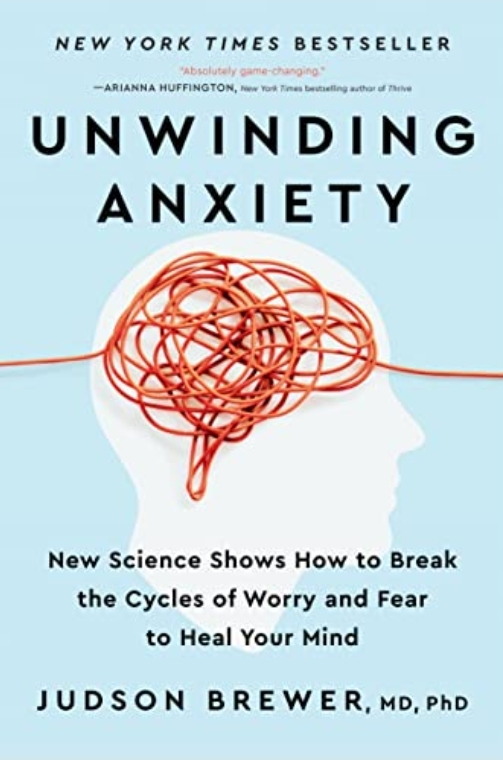
(Incidentally, unwinding anxiety is the best metaphor for how this junk is all tangled up in my brain like a trunk full of last year’s Christmas lights. Absolute perfection.)
Overall I found this book helpful, particularly as someone who experiences severe anxiety, disability from anxiety and cancer, and an unceasing desire to understand how things work.
I’ve listened to Unwinding Anxiety a few times through now. I’m reluctant to praise anything too much, because I know how isolating and depressing it can be to want relief and not find it in places where others have. This Review of Unwinding Anxiety comes with a disclaimer.
Applying Brewer’s approach to my own anxiety and IBS seems to be working for me, but it might not be as healing for you. I want you to know that I see and fully acknowledge your struggle.
I’ve been stymied by that battle for what feels like an eternity, and I only drop affiliate links to make this book easier to access if you’re curious. Not because I think there’s a miracle, one-size-fits-all cure for this shit. If nothing else, reading could lead you to discover something that helps you more. That’s all I expect anyone to get from my review today.
But listen to me: if it doesn’t help like you want, it’s not your fault. It’s so important to me that you know that.
I still have anxiety, and I will always be prone to my anxious tendencies. The difference is that now I recognize it, have tools that can help me process it, and can clearly see the benefit of applying those tools.
Like I said a few days ago, I’m not moved much by woo. I prefer hard science, and Judson Brewer broke it down for me in this book. He explained his research plainly, and I found his writing clear but thorough.
Still, I’m the type who picks up on new things every time I read—it’s like when I’m rewatching a favorite movie and I notice something for the first time. I intend to give the audiobook a third listen after the initial ideas in Unwinding Anxiety have had a little more time to simmer.
Unwinding My Own Anxiety
My earliest memorable dealings with anxiety harken back to when I was about 8. I was in bed one night trying to sleep when I thought about the story of John Henry. We’d sung a song about him in music class earlier that week.
When I thought about Henry’s death and then realized my own was inevitable, I struggled to breathe. I felt sick to my stomach and hung out by the toilet for the night. It was my first panic attack, and I have only this week come to understand that’s what was happening.
Unfortunately, my best friend was sleeping over that night, and she wanted to go home. Adult me totally gets it, but little me was kind of heartbroken that my best friend didn’t want to hang out. Her mom or her grandma or someone came to pick her up. I was not just feeling anxious, I was feeling rejected.
My parents tried to console me that night, but I don’t think they understood my experience because I didn’t have words to articulate my fear. Besides, even at 8 years old, I already understood that I should probably just get a grip.
I got that same anxious feeling in my gut about Gifted & Talented class and tried to quit. But the G&T teacher was a hardass. She told me I couldn’t quit unless my parents wrote a note. I thought I’d be a disappointment to them—and I didn’t want to break their hearts—so I stayed in the program and never again brought it up.
And so it went for another 36 years.
I knew when I got stressed and anxious, my IBS would show up, but I had no clue I had developed full-blown generalized anxiety disorder until I heard Brewer define it. Then I remembered the joke I saw on Twitter about all the G&T kids being perfectionists with anxiety.
Hahahaha. Heh.
*nervously glances around room*
That plus recalling Dr. Pulmonologist recently noting the connection between IBS and anxiety caused me to have a lightbulb moment while listening to Unwinding Anxiety.
If I didn’t have a brain tumor to worry about, I might have put the pieces together sooner. After all, I have been diagnosed with anxiety because of my health.
Detailing My Anxiety Loops
Trying to get the anxiety and IBS to stop without understanding the connection was futile. My chronic illness and the physical manifestations of my GAD, were woven too tightly together.
With each new physical symptom, I’d spiral and feed the anxious habits I’d been actively suppressing for a lifetime. Every new doctor’s appointment made it all worse.
The constant internal battle over needing to know what was wrong with me but also needing to not have another expensive doctor’s appointment drain my bank account magnified my anxiety and made my IBS an even bigger problem. To the point I was noticing disordered eating in an attempt not to shit my pants. Sometimes not wanting to eat at all. When I would finally give in and eat because I knew I needed calories to stay alive, there would be even more severe consequences.
When Mom would join us for a meal, I’d stress about getting to the bathroom in time after eating. Or I’d fret about choosing the “wrong” food when ordering takeout, et voilá. I’d give the IBS something to IBS about. I’d try to identify trigger foods only to realize everything caused GI distress and be certain I was hopelessly broken. The suffering was endless.
Also? “You have cancer, we should see if this is cancer too” every few weeks might have been medically sound advice, but it was disastrous for my mental health. My doctors and I didn’t know what we didn’t know.
Pausing My Catastrophic Spirals
Garden variety anxiety had been on my radar for a while. So I tried earnestly to meditate myself to calm. The problem was that my anxiety had anxiety, as they say. Or, put another way, I was anxious I’d be anxious again. I was a hot mess.
I’m still a hot mess, if I’m honest. But Unwinding Anxiety has helped me understand what triggers my anxiety loops, why just mapping the loops helps, and how a subtle shift in how I meditate gets me to recognize what’s happening and press pause on the unraveling.
My brain has always been trying to help, since I was a kid, but I ended up very literally addicted to worry.
Evidence My Anxiety Was Exacerbating My IBS
Grasping for answers made me feel worse. Nothing is clearer to me now. Brewer encourages the anxious who try his approach to not just scrutinize his evidence, but look for their own.
I’m wary of things helping for a short time and ceasing to be therapeutic, BUT
My guts aren’t as inflamed. Which means my lungs have more room to expand and my breathing isn’t as shallow as it was just last week.
I can also hug both of my knees to my chest without any pain in my abdomen—something that inflammation and excruciating pain had made impossible for the last couple of years.
I am still eating “bad” foods, but my IBS-D episodes are farther between and less severe. I haven’t had an IBS-C bout since my first listen. Though it’s too early to say anything about IBS-C with certainty as that has always been an intermittent issue.
That level of improvement with my IBS coupled with my vastly improved mental well-being—in such a short time—is enough for me to keep on keeping on and write this long-ass post.
2018 is the year I completed chemo. That’s why I started off listening to most of my books via Audible (try it with my link and get 2 free books) and then switched to print or Kindle the more distance I put between me and that final dose of Gleostine.
I had a Goodreads goal of reading 20 books this year, and got all the way to 25 books before completely crapping out at the end. Some books were better than others, so I want to highlight my faves first. Then, if I’m not completely exhausted, I will list the rest of the books at the end.
“Her name was Henrietta Lacks, but scientists know her as HeLa. She was a poor black tobacco farmer whose cells—taken without her knowledge in 1951—became one of the most important tools in medicine, vital for developing the polio vaccine, cloning, gene mapping, and more.”
This is the really touching memoir of the daughter of a hoarder. I was emotionally wrapped up from the beginning, and I feel like reading this book made me a better, more understanding person. What you see of the lives of families on the show Hoarders, for example, is just the tip of the iceberg.
Believe it or not, I hadn’t heard of this delightful book until it became a movie. (I know, I know.) So to keep my Book Nerd card, I decided that I must read it before seeing it. I loved it. Then I heard from friends that the movie was disappointing, and I decided not to watch the movie at all. Did any of you see the movie?
Artemis by Andy Weir
This book is by the same guy who wrote The Martian, which I also loved. Space books make me feel dreamy and happy, and Artemis involves a heist that takes place on the moon. Super fun!
I loved this book based on the real-life affair between Martha Gellhorn and Ernest Hemingway. (OMG, he was such a jerk.) Anyway, I’m always fascinated by people who (in my estiation) make destructive decisions, and these two definitely did. Whooooeee.
This is some fun YA fantasy right here. (It’s part of a series–as you’ll see, I read three other books by Holmberg back to back to back to back.) Ceony Twill, our protagonist, is assigned an apprenticeship in paper magic and crushes on her mentor. (It’s not gross though.) And they have to fight bad magic with good magic.
(Full disclosure, in the mid-aughts I worked for Hank’s brother, John.) I liked this book, and then I got really irritated by some things, and then I liked it again, and then I was like, “HOW DO I FEEL ABOUT THIS BOOK?” It’s like this: a bunch of robots show up on earth mysteriously, and then the main character accidentally gets YouTube famous because of it. And then fame makes her kind of horrible.
This memoir was good, but it ran me through the wringer emotionally because: brain tumor. I love Uncle Joe, and I really admire his ability to hold on to his HUMANITY, even as a politician. If you have a brain tumor or love somebody with a brain tumor, you should be prepared to feel your feels.
You know I’m writing a memoir, right? That’s why I picked this book up at the Champaign Barnes & Noble toward the end of the summer. It’s got some great advice for writing memoir but also wonderful suggestions for us as we read memoir. I scribbled several notes in the margins of its pages as I contemplated how I wanted to write and organize my own book.
Everything Else
So, that’s my list. What books did you read this year that really stick out for you?
This book was written by the guy who wrote The Martian and performed by Rosario Dawson. (I love her.) It’s about a heist that takes place on the moon. It’s witty and science-y.
This was a hard read for me, seeing how the book was equal parts family story and political memoir. If you don’t already know, Joe’s son died of a brain tumor. That made this book a bit of a traumatic read for me. But it was also comforting. I’m a bigger fan of Joe Biden having read this book, and I already thought pretty highly of him.
Just a coincidence that Artemis appears in the title of this too. It’s what I’d call YA Fantasy and it was a fun distraction. I listened to this (and other titles) on Audible during chemo week and during my two-hour visits to Expanded Care for my IV fluids. The guy reading this book was fantastic, a true voice actor.
This is the memoir of a woman whose parents are hoarders. You’ll laugh; you’ll cry. And you’ll be reminded that the people on that TLC show are real people and, I believe, understand them just a little bit better. I loved this book, and I think Kimberly Rae Miller is a gem.
Somehow I had managed to never hear of this book until I was 38 and it was being released as a Disney movie. It was decent, but I think I would have enjoyed it immensely more if I was 12.
I also listened to this book on Audible. For a book about a high-profile kidnapping, it was a long slog. I finished listening more out of duty than enjoyment. In fact, I ended up changing the playback speed to 2x real time just to get it over with. Perhaps it would have been more enjoyable as a read instead of a listen.
Read this one on my Kindle before my headaches got to be a little too frequent, and it was good. It’s about a woman who works at a suicide hotline looking for candidates to encourage to commit suicide. I’d give it four stars and a trigger warning.
I blurt that periodically. Like, every time he publishes a new book. Maybe because I’m an ordinary person with no claim to fame of my own, I dunno. I do know that at one point he was my boss. The last time I put that tidbit on a resume, one of my interviewers was like “no way!” and I was like “way.”
I got that job, but I’m pretty sure that’s not the only reason why. Pretty sure.
Anyway, if you’ve never been here before or you just haven’t had the chance to keep up with my blog for the last eight months, you should know I have a brain tumor. I promise it’s relevant to my review of Green’s Turtles All the Way Down, but it’s going to look like it’s not for just a minute or two.
Last night I asked Twitter what those tiny purplish dots on the pads of my fingers might be. When I first noticed them, I thought they were ink. (From what, exactly, I didn’t know; I hadn’t picked up a writing utensil in several weeks.) So I tried to wash them off without any luck.
However, with the help of the wonderful @mumsintheattic, I settled on them being chemo-induced thrombocytopenia.
Basically my blood quality sucks because of chemotherapy, and—voila!—microbruises. Turns out they’re kind of painful. The pain sensation is something akin to the prick you feel having your blood sugar tested. Only it’s hundreds of tiny locations, on all my fingers, and the pain lingers for hours instead of seconds.
I got thrombocytopenia from reading Turtles All the WayDown, because the weight of the hardcover on my hands was too much for my clot-challenged blood. So my finger tips bruised.
Suddenly Natasha Bedingfield just seems kind of, well, whiny. Am I right?
***
February 9, 2017 was the day Dr. Beaumont cut my head open. And though I’m certain he didn’t mean to, his knife work tweaked some already overzealous muscles in my head, neck, and shoulders. (The muscles seem to be terribly afraid that if they don’t wrench and clench twenty-four-seven, my head might actually fall off my body.)
Said muscles are so constantly worked up that they pinch a nerve, and the nerve invariably sends a signal back to the constricted muscles: WRENCH AND CLENCH HARDER. If there’s such a thing as neck sciatica, I have it.
This pain is exacerbated when I hold things like my cell phone or, say, a hardcover copy of Turtles All the Way Down. So at the end of every chapter (God bless authors who write short chapters) I’d put the book down and take a couple of deep breaths. Then I’d pick it back up despite myself and wince.
***
This is where the 100% spoiler free review comes in.
The fact that I read this book in less than 24 hours while causing myself more pain (more as in more than chronic pain) is a testament to how great it is. I particularly recommend it to my Spoonie friends. (Have a tissue when you get to page 89.)
If you’re thinking about buying it, do. You can use my Amazon affiliate link, and I’ll make a few cents. Which I will probably use to buy more books that cause me pain.
So, remember how in my last post I was all, “I’ve got ideas for this blog” and “contributors” and “news forthcoming.”
Yeeeah, no.
After further reflection, I’ve decided the last thing I want to do right now is give myself another writing project. The day job and my freelancing work provide the perfect number of deadlines for the time being.
Besides, I’m enjoying coming home from work with energy left to exercise my brain, so I’ve been letting myself indulge in books. Since moving to Champaign, I’ve read:
Redshirts
Losing It
Chelsea Chelsea Bang Bang
In the Garden of Beasts: Love, Terror, and an American Family in Hitler’s Berlin
Miss Peregrine’s Home for Peculiar Children
Drift
The Night Circus
That might not seem like a lot for the hardcore book nerds out there, but eight books since September trumps my January through August average by, like, I dunno…a lot. I attribute my newfound energy and desire to read again to two things: going back to Central Time and having access to natural daylight at the new day job.
Anyway, of the eight titles listed, I’d have to say that In the Garden of Beasts: Love, Terror and an American Family in Hitler’s Berlin was my favorite. Despite the horrible title, it was a fascinating read. It’s by Erik Larson, the guy who wrote Devil in the White City, and it follows the lives of the reluctant American ambassador to Germany and his family at the time Hitler was coming to power
A fair number of people on Goodreads complained about how much attention Larson gave to the ambassador’s daughter’s scandalous love life. I think those people are idiots. First of all, her diary provided a first-person account of a historically significant period. Second of all, that a member of the Nazi party tried to set her up with Hitler, that she fell in love with a guy in the Russian military, that she slept with whomever she pleased in 19-freaking-33, that her escapades complicated life for her dad—those things are damn relevant to a story about the ambassador and his family.
My one caution: Because Larson quotes primary sources where he can, the prose can get a little clunky. This one reads closer to the non-fiction it is, where Devil in the White City reads a little more novel-like. Prepare yourself for grammatical structures that are a little more complicated than “See Dick run.”




 Try Audible and Get Two Free Audiobooks

